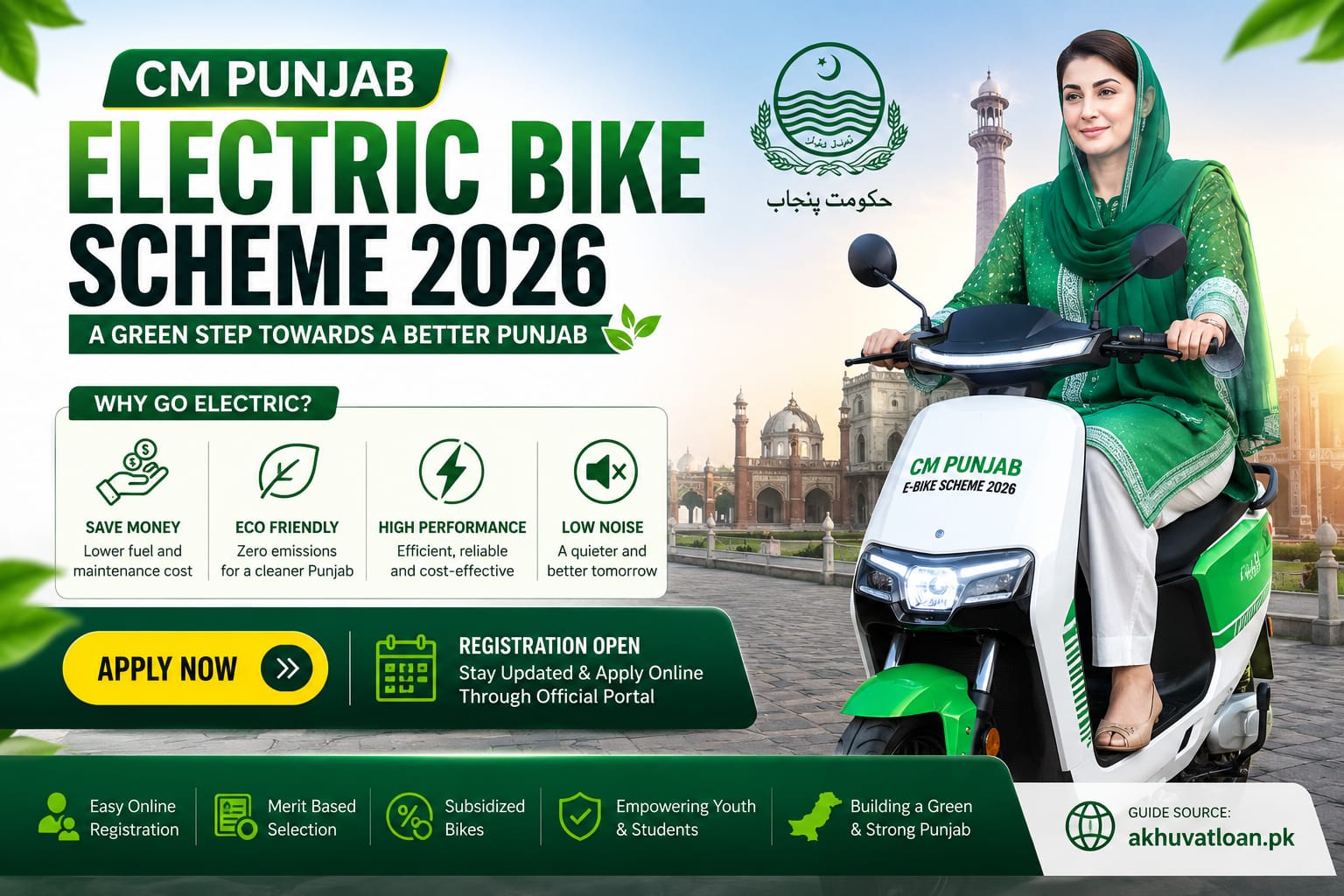
CM Punjab Electric Bike Scheme 2026: Complete Guide, Eligibility, Registration & Latest Updates
The CM Punjab Electric Bike Scheme 2026(e-bike) is one of the biggest student and youth mobility initiatives launched by the Government of Punjab, aimed at making daily commuting affordable through interest-free electric and petrol bikes. With rising fuel prices and overcrowded public transport across Punjab, the scheme has quickly become one of the most talked-about welfare programs of the year, especially after its expansion in Phase 2 to cover all 36 districts of the province. In this guide, I’ll walk you through everything you need to know about the scheme, how it actually works on the ground, and later on, I’ll also share my own experience of applying for it as a student.
سی ایم پنجاب الیکٹرک بائیک اسکیم 2026 (ای بائیک) حکومتِ پنجاب کی جانب سے شروع کی گئی طلبہ اور نوجوانوں کے لیے موبیلٹی کی سب سے بڑی سکیموں میں سے ایک ہے، جس کا مقصد بلاسود الیکٹرک اور پیٹرول بائیکس کے ذریعے روزانہ کے سفر کو سستا بنانا ہے۔ پنجاب بھر میں پیٹرول کی بڑھتی ہوئی قیمتوں اور پبلک ٹرانسپورٹ کی بھیڑ کے پیشِ نظر، یہ اسکیم بہت جلد سال کے سب سے زیادہ زیرِ بحث فلاحی پروگراموں میں شامل ہو گئی ہے، خاص طور پر فیز 2 میں توسیع کے بعد جس میں پنجاب کے تمام 36 اضلاع کو شامل کر لیا گیا ہے۔ اس گائیڈ میں، میں آپ کو اس اسکیم سے متعلق ہر ضروری بات بتاؤں گا، یہ عملی طور پر کیسے کام کرتی ہے، اور آخر میں میں ایک طالب علم کے طور پر اس کے لیے اپلائی کرنے کا اپنا ذاتی تجربہ بھی آپ کے ساتھ شیئر کروں گا۔
What Is the CM Punjab Electric Bike Scheme 2026
The CM Punjab Electric Bike Scheme 2026 is a subsidized mobility program launched by the Government of Punjab under Chief Minister Maryam Nawaz, in partnership with the Bank of Punjab (BOP). The idea behind it is simple: daily commuting is eating up a huge chunk of a student’s, teacher’s, or government employee’s monthly budget, so the province is stepping in to make electric and petrol bikes available on interest-free installments.
For context, an average student in a city like Lahore or Multan can spend anywhere between PKR 5,000 and PKR 8,000 a month just getting to and from campus. For a government school teacher posted in a rural tehsil, that figure can climb even higher because of longer distances and fewer transport options. The scheme was designed to take a bite out of that expense by putting thousands of brand-new electric bikes, scooties, and petrol motorcycles into the hands of people who genuinely need them, without charging any markup on the loan.
Why the Punjab Government Launched This Initiative
Punjab has been dealing with rising fuel prices, overcrowded public transport, and a growing number of students who simply can’t afford daily commuting costs anymore. The provincial government positioned this scheme as part of a wider youth empowerment and green mobility push, aiming to reduce dependence on petrol while also giving young people, teachers, and low-income government workers a practical way to become independently mobile.
There’s also an environmental angle here. Electric bikes cut fuel consumption dramatically compared to petrol motorcycles, and the government has been keen to frame the scheme as a step toward cleaner urban transport in cities that already struggle with air quality.
Phase 1 vs Phase 2: What Changed
When the scheme first rolled out, it was fairly limited in scope. Understanding the difference between the two phases matters a lot if you’re trying to figure out whether you qualify right now.
Phase 1 Coverage
The first phase of the CM Punjab Bike Scheme was restricted to students only, and only in five major cities: Lahore, Faisalabad, Multan, Rawalpindi, and Bahawalpur. Roughly 20,000 bikes were distributed during this stage, with the vast majority being petrol motorcycles and a smaller portion set aside as electric bikes. If your campus wasn’t physically located in one of those five cities, you simply weren’t eligible during Phase 1.
Phase 2 Expansion
Phase 2 is where things got interesting. The scheme expanded to cover all 36 districts of Punjab instead of just five cities, which opened the door for thousands of students in smaller towns and rural areas who had been left out earlier. Scooties were added specifically for female students, and for the first time, two brand-new categories were introduced: government school teachers and government employees in BPS grades 1 to 16. The teacher category alone is expected to cover around 5,000 educators initially, with plans to expand further in later rounds.
If you live outside those original five cities, or if you’re a teacher or a government employee, Phase 2 is genuinely the first real opportunity for you to take part in this program.
Eligibility Criteria for CM Punjab E-Bike Scheme 2026
Before you get your hopes up, it’s worth checking whether you actually meet the requirements. Based on the official guidelines and portal information, here’s what applicants generally need:
- Must hold a valid Punjab domicile and CNIC (or B-Form for younger applicants where applicable)
- Must be at least 18 years old
- Must be a regular student enrolled in a degree college or university recognized by the Higher Education Commission (HEC), or fall under the teacher/government employee categories introduced in Phase 2
- Must possess a valid learner’s permit or motorcycle driving license
- Only one sibling per household can receive a bike, even if both apply and both clear balloting
- Selected applicants must pass Bank of Punjab’s financial verification before the bike is actually handed over
A common mistake people make is assuming eligibility alone guarantees a bike. It doesn’t. You still have to clear the computerized balloting round and then pass BOP’s scrutiny process, which checks your financial background and guarantor details.
Step-by-Step Registration Process
The application process is entirely digital, which honestly makes it a lot less painful than older government schemes that required standing in long queues at district offices. Here’s how it generally works:
- Visit the official portal at bikes.punjab.gov.pk (students) or ptf.punjab.gov.pk (teachers, managed by the Punjab Teachers Foundation)
- Register using your CNIC number, an active mobile number, and email address, then verify through an OTP
- Fill in your personal information, educational qualification, and institution details
- Upload the required documents, including your CNIC or B-Form, student ID card, and learner’s permit or driving license
- Choose whether you want an electric bike or a petrol bike
- Submit the application and save your tracking ID
- Wait for the computerized e-balloting results, which are announced via SMS and published on the official website
- If selected, complete Bank of Punjab’s financial verification to finalize your bike allocation
I’d strongly suggest getting every document scanned clearly before you even open the form. A blurry upload or an incomplete field is one of the most common reasons applications get rejected, and it has nothing to do with actual eligibility.
Installment Plan and Subsidy Details
One of the biggest selling points of this scheme is the payment structure. Reports suggest the government is covering close to half the total cost of each bike, and the remaining amount is spread out over a two-year installment plan through Bank of Punjab, with zero markup.
Rough estimates for monthly installments look like this:
- Electric bikes: around PKR 2,000 to PKR 3,000 per month
- Petrol bikes: around PKR 3,000 to PKR 4,000 per month
Ownership of the bike transfers fully to the applicant once the two-year installment period is complete. Given that electric bikes reportedly cut running costs by close to 80 percent compared to petrol motorcycles, many students end up saving more on fuel each month than they’re paying in installments, which is a big part of why demand for the electric option has been so high.
Quota System and Reserved Categories
To keep the distribution fair, the scheme reserves specific quotas for different groups. Based on available information, this generally includes a significant share for female students, a portion set aside for rural applicants outside the major cities, and a smaller reserved percentage for persons with disabilities and minority communities. Selection within each quota still happens through random e-balloting, which is handled by Punjab’s IT board rather than any manual or discretionary process, so there’s no shortcut through political connections or personal influence.
Electric Bike vs Petrol Bike: Which Should You Choose
This was actually the hardest decision for me personally. If your college or university is close to home and you have a safe spot to charge a battery, an electric bike makes a lot of sense financially. The running cost is dramatically lower, and maintenance tends to be simpler too. But if your daily commute covers a longer distance, or you live in an area where charging infrastructure isn’t reliable yet, a petrol bike might genuinely be the safer and more practical option, at least for now.
My own campus was about 12 kilometers from home, which is right in that in-between zone. I ended up going with the electric option because I had a charging point available at home, and honestly, the fuel savings alone made the installment feel almost negligible.
My Personal Experience Applying for the Scheme
I applied during the Phase 2 window as a university student in Lahore. The registration itself took me less than twenty minutes because I had all my documents ready beforehand: my CNIC, student card, and learner’s permit scanned in advance. What surprised me was how transparent the tracking system felt. I could log in with my CNIC or tracking ID and actually see where my application stood instead of just waiting blindly for a phone call that might never come.
The balloting result came through SMS a few weeks later, and I remember being genuinely nervous checking my phone that morning. Once selected, the financial verification stage with Bank of Punjab felt a bit more bureaucratic, but it wasn’t unreasonable. They mainly wanted confirmation of my guarantor’s details and basic income information. A friend of mine who applied around the same time wasn’t as lucky. He cleared the balloting but got stuck at the verification stage because his documents didn’t fully match, and there’s no appeal process for that, so he had to reapply in the next round with corrected paperwork.
Overall, my experience with the CM Punjab e-Bike Scheme was smoother than I expected from a government program, and the monthly installment has genuinely been easier on my budget than what I used to spend on rickshaws and vans every month.
Common Mistakes Applicants Make
A few patterns kept showing up among people I know who applied for this scheme:
- Rushing the application before scanning all required documents, leading to blurry or missing uploads
- Not confirming their learner’s permit or driving license was valid before starting the form
- Assuming that being selected in balloting automatically guarantees the bike, without accounting for financial verification
- Forgetting that only one sibling per household can receive a bike, which caused confusion for a few families I spoke to
Frequently Asked Questions
Final Thoughts
If you’re a student, teacher, or government employee in Punjab struggling with rising commute costs, the CM Punjab Electric Bike Scheme 2026 is genuinely worth applying for, especially now that eligibility has expanded well beyond the original five cities. Just make sure your documents are in order before you start the form, understand which category you fall under, and don’t assume balloting selection is the finish line. Based on my own experience, if you get the paperwork right the first time, the whole process from registration to actually riding your own bike can move faster than most government schemes ever do. Since eligibility criteria, installment amounts, and registration windows can be updated by the Punjab government at any time, it’s a good idea to confirm the latest details directly on the official portal (bikes.punjab.gov.pk) before applying.
CM Punjab Ration Card – Complete Guide for Deserving Families (2026)
Rising inflation has made daily life extremely difficult for low-income and middle-class families across Punjab. Buying basic food items like flour, cooking oil, sugar, and pulses has become a serious challenge. Because of this situation, thousands of families are searching online for accurate information about the CM Punjab Ration Card and how to benefit from…
How to Apply for Punjab Parwaz Card Online Through the Official Portal (2026 Guide)
Many skilled individuals in Punjab successfully secure overseas job offers but fail to proceed due to high pre-departure expenses. Costs such as visa processing, medical tests, protector fees, travel tickets, and documentation often create a financial barrier. As a result, deserving workers are forced to delay or completely lose valuable foreign employment opportunities.To address this…
Asaan Karobar Finance Scheme Punjab 2026 – Complete Business Loan Guide
Starting or expanding a small business in Punjab often becomes difficult because of limited financial resources. Many people have strong business ideas but lack access to affordable funding. To solve this problem, the Government of Punjab introduced the asaan karobar finance scheme. This initiative is designed to support entrepreneurs, shop owners, and small business operators…
BISP 8171 December 2025 Payments – Eligibility, Status Check & Complete Guide for Pakistan
December becomes especially challenging for families registered under BISP 8171 as winter expenses rise and household budgets come under pressure. Higher food costs, heating needs, warm clothing, and year-end school fees make this month financially stressful for many low-income households in Pakistan. On top of these challenges, uncertainty about payment eligibility, verification, and release dates…
Apni Chat Apna Ghar Scheme Register Online 2026 (اپنی چھت اپنا گھر اسکیم رجسٹر آن لائن)
Apni Chat Apna Ghar Scheme Register Online 2026 (اپنی چھت اپنا گھر اسکیم رجسٹر آن لائن) When a family wants a safe and permanent home, the biggest challenge is always affordability. Many low-income households in Punjab struggle with high rents, rising construction costs, and limited financing options. Apni Chat Apna Ghar Scheme has been introduced…